

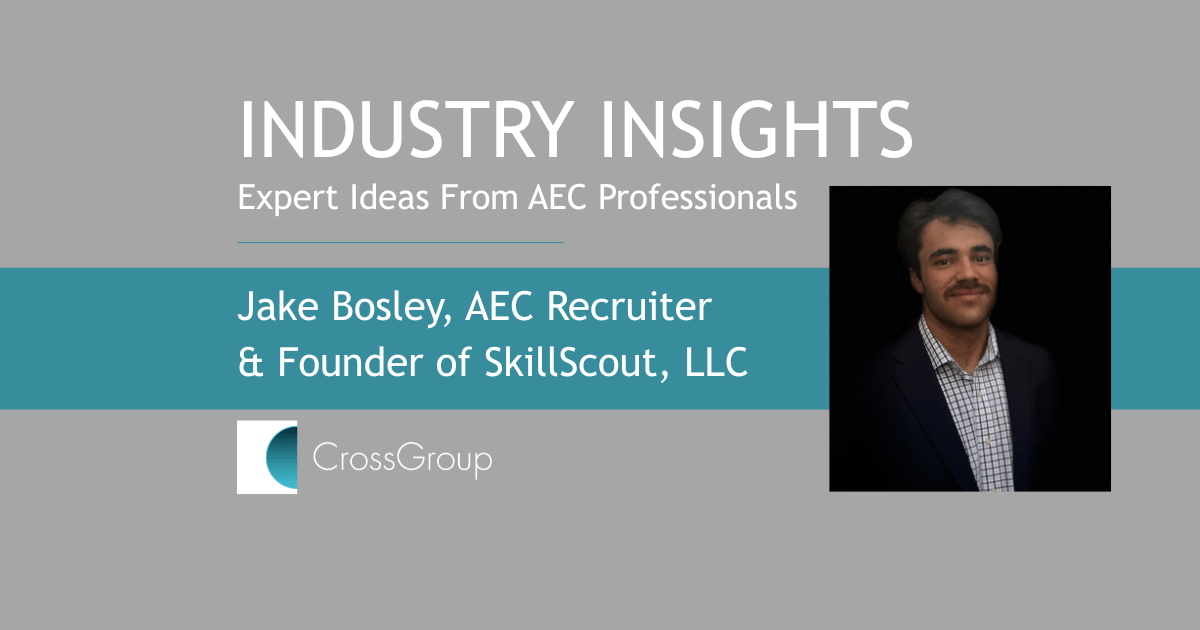
At CrossGroup, we are privileged to get to know many professionals inside the complex and rapidly changing world of AEC, and not all of them are engineers. One of the pros we’re proud to know is Jake Bosley, AEC recruiter and founder of SkillScout, LLC. Jake is clearly passionate and deeply knowledgeable about the industry he serves, and his drive is reflected in SkillScout’s mission: Making Unattainable Talent Achievable.
This incisive grasp of the industry inspired us not only to interview Jake, but also to start a new series of posts we’re calling Industry Insights. Keep an eye out for future interviews featuring different perspectives on AEC and how the industry is navigating change and shaping the future.
Here’s our interview with Jake:
Jake, thanks for talking with us. First of all, how would you describe SkillScout and your approach to recruiting?
Skill Scout is a civil engineering and architecture-focused recruitment company that focuses on partnerships over transactional relationships. Our approach goes beyond getting a job description and searching through job boards for a match. Instead, we embed ourselves with our partners by meeting with employees at multiple levels to understand their culture, uncover the real reasons behind their openings, and highlight their unique strengths.
We find that identifying a hirable candidate for one of our partners is only a result of being an extension of their organization, not just an outside vendor.
What is unique about your experience and perspective?
What makes my perspective unique is my prior experience working inside a top civil engineering firm. That gave me firsthand insight into the nuances of why positions open up in the AEC industries, and how the right hire can shift a team’s trajectory. I bring that lens into recruiting, ensuring every search is informed by industry context rather than guesswork.
What insights can you share into industry trends and other issues impacting AEC firms’ recruiting efforts currently?
The TxDOT slowdown has put a lot of pressure on transportation-focused companies in Texas. The slowdown has given real insight into how critical diversification really is. Groups that have business lines in both aviation and land development have seen an uptick in work this year, which has consequentially resulted in an uptick in recruitment.
Beyond client/backlog demand, there are two major factors firms need to address to stay competitive in recruiting:
- Compensation: Pay has always been a key driver in recruiting and retention, but the gaps I’m seeing now are wider than ever. For example, offers for mid-level licensed engineers can vary by as much as 25% between the low and high end. This creates a clear disconnect between general market salary data and what some firms are actually offering. With cumulative inflation from 2021 through August 2025 at 24%, offers that haven’t adjusted accordingly are often declined in favor of those that have.
- Local vs. flexible hiring: Pre-pandemic, the standard approach in engineering was to hire staff directly into the office where they’d be working. On paper this makes sense, but in practice it slows projects down when talent in that specific geography is limited. The result becomes delayed schedules, work being turned down, and existing teams stretched too thin.
What’s different in 2025 is the rise of technology and workflows that make remote or satellite collaboration viable. The firms winning in recruitment are opening roles beyond just one office. For instance, if a client needs a Project Engineer in Houston, they’ll now consider candidates across all of their Texas offices. This widens the talent pool and increases the odds of finding someone who’s a strong technical and cultural fit.
What are the biggest recruitment and retention challenges firms are facing right now?
- Industry Consolidation and Acquisitions: One of the biggest hurdles for small and mid-size firms is the uptick in acquisitions. Larger, national consultants often have the financial resources to outbid smaller firms when it comes to offers. This makes it difficult for independents and regional players to compete purely on salary or benefits. As a result, they must get creative- differentiating through culture, flexibility, career progression, or specialized project opportunities. You will also give yourself an advantage by having a more personalized and timely hiring process than the large consultant outfits- more on this below.
- Licensure: Another issue I consistently hear from candidates is the challenge of pursuing licensure while meeting the demands of project work. Many motivated engineers want to earn their P.E., but the lack of time to properly prepare for the exam holds them back. For firms, this creates a bottleneck at the mid-senior level where licensed engineers are essential for project leadership. Supporting staff with study resources, mentorship, or time off to prepare can make a real difference in both retention and advancement.
- Long Hiring Processes: Finally, one of the most immediate challenges is how drawn-out hiring processes turn top candidates away. We’ve all heard the sayings: “time kills all deals” and “strike while the iron’s hot.” There’s truth to these cliches. Candidates tell me things like:
- “It seems like they don’t really want me. They just want my technical skills.”
- “They seem unorganized, and it makes me less interested.”
- “They’re taking too long and might not even meet my expectations on salary or flexibility. I think I’ll pass.”
The fix to this is simple- define everything when hiring. A quick whiteboard session with your hiring authorities can save weeks of frustration and increase your chances of landing top talent. A few practical steps:
- Set a clear timeline. In my experience, 2-3 weeks is the sweet spot for most successful hires.
- Outline the process. Based on my 2025 offer data, firms are about 70% more likely to have offers accepted when their process includes at least two touchpoints between team leaders and staff.
- Establish a salary range. Transparency attracts talent. I consistently get more responses when salary ranges are included in outreach, which means more viable candidates for firms.
- Define the career path. Nobody wants to feel pigeonholed. The firms winning in today’s market are clear about what advancement looks like, and some even provide rough timelines for growth.
What matters most to top-level talent? Does it differ by generation or length of tenure?
Oftentimes, what matters to top-level talent changes as experience increases.
Entry-Level Engineers: Exploration
For those just starting their careers, the top priority is exploration. These engineers want exposure to multiple disciplines before committing to a single track. I regularly speak with young engineers who accepted their first job without giving much thought to specialization, only to realize later that another discipline might be a better fit. The earlier they’re given the opportunity to rotate through different types of work, the more likely they are to find the right fit and stick with an employer long term.
Midlevel and Mid-Senior Engineers: Compensation, Benefits, Flexibility
As engineers move into their late 20s and 30s, their priorities shift. This is often the stage where they’re buying homes, starting families, or taking on bigger financial responsibilities.
At this point, competitive compensation packages, strong benefits, and workplace flexibility become the deciding factors. A supportive environment that allows them to balance professional growth with personal responsibilities can make all the difference in retention. Firms that recognize this balance stand out in a competitive market.
Senior-Level Engineers: Leadership and Legacy
For senior professionals, the focus shifts again. At this stage, it’s more about impact. Senior engineers want a seat at the table. They’re seeking opportunities to lead regional teams, shape strategy, and leave a legacy within the organization. Many are motivated by the chance to mentor younger engineers and take on firm-wide or region-wide leadership roles. Recognition, influence, and the ability to contribute to long-term organizational direction often outweigh other considerations.
To learn more about Jake’s services and SkillScout, LLC, email jbosley@skillscoutllc.com, follow Jake on LinkedIn or visit skillscoutllc.com.
Interested in learning more about how CrossGroup can help you develop your people? Follow us on LinkedIn to be notified about our next event!